
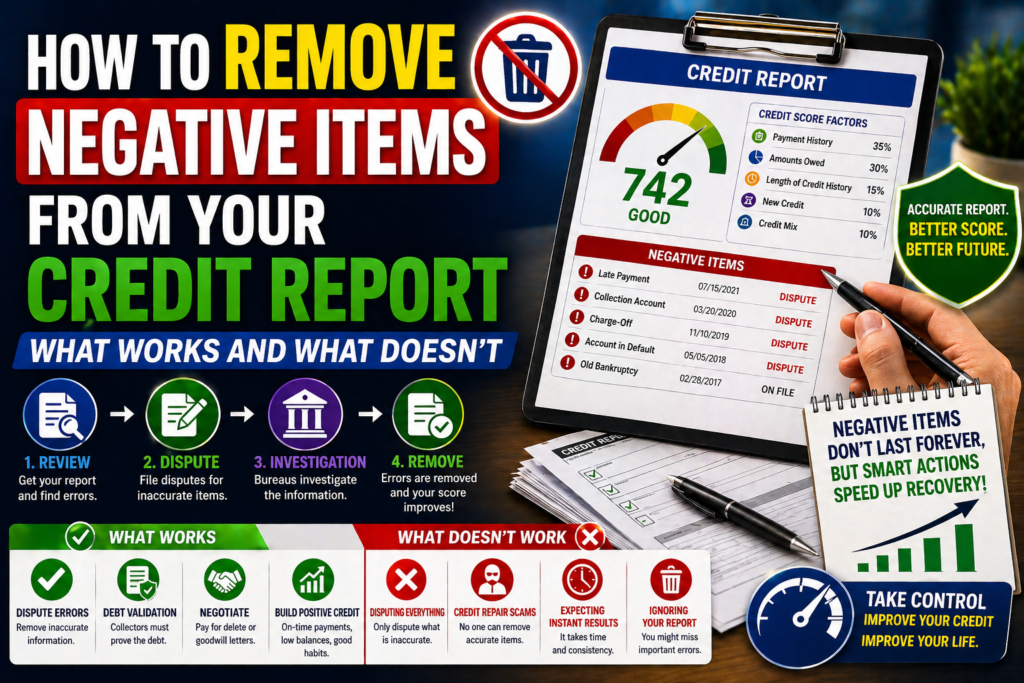
How to Remove Negative Items from Your Credit Report: What Works and What Doesn’t
Negative items on your credit report can seriously impact your financial life—but not all of them are permanent, and some can even be removed.
The problem is that there’s a lot of misinformation around this topic.
In my experience helping people deal with credit issues, one of the biggest misunderstandings is believing that any negative item can be removed. That’s simply not true. However, there are specific situations where removal is absolutely possible—and knowing the difference is key.
Can You Remove Negative Items from Your Credit Report?
The short answer:
👉 Yes—but only in certain situations
You CAN remove negative items if they are:
- incorrect
- outdated
- duplicated
- unverifiable
You CANNOT remove negative items if they are:
- accurate
- recent
- properly reported
👉 This is the most important concept to understand before doing anything else.
In my experience, unrealistic expectations are what cause most frustration in credit repair.
Types of Negative Items on a Credit Report
Before removing anything, you need to understand what you’re dealing with.
Common negative items:
- late payments
- collections
- charge-offs
- defaults
- bankruptcies
- hard inquiries
Each type has different rules and removal strategies.
Step 1 — Get and Review Your Credit Report
You can’t fix what you don’t analyze.
What to check:
- personal information
- account details
- payment history
- duplicate entries
Look for:
- accounts you don’t recognize
- incorrect late payments
- wrong balances
- outdated items
In my experience, most people find at least one issue when they review their report carefully.
Step 2 — Dispute Inaccurate Information
This is the most powerful and legitimate method.
How disputes work:
- you notify the credit bureau
- they investigate the claim
- they verify the information with the creditor
If the item is:
- incorrect → it must be removed
- unverifiable → it must be removed
Timeline:
- typically 30 days
In many cases I’ve seen, removing just one incorrect item can significantly improve a credit score.
Step 3 — Request Debt Validation
For collection accounts, you can request proof.
What this means:
- asking the collector to verify the debt
If they cannot:
- the item must be removed
👉 This is one of the most overlooked strategies.
Step 4 — Negotiate “Pay for Delete”
This is a more advanced strategy.
How it works:
- you agree to pay a debt
- the creditor agrees to remove it
Important:
- not all creditors accept this
- agreements should be in writing
In my experience, success depends on the creditor and your negotiation approach.
Step 5 — Send Goodwill Letters
For legitimate negative items, especially late payments:
You can:
- request removal as a gesture of goodwill
- explain your situation
- show improved behavior
Works best when:
- you have a strong payment history
- the issue was temporary
Step 6 — Wait for Automatic Removal
If an item is accurate and cannot be removed:
It will fall off after:
- most items → 7 years
- hard inquiries → 2 years
- bankruptcies → up to 10 years
👉 Time is part of the process—but not the only strategy.
What Does NOT Work (Common Myths)
Avoid these misleading ideas:
“You can remove everything”
False. Accurate information stays.
“Credit repair companies can delete anything”
They cannot remove valid data.
“Disputing everything will fix your credit”
Untrue—and can backfire.
In my experience, focusing on legitimate strategies produces real results.
How Removing Negative Items Affects Your Score
When negative items are removed:
- your credit report improves
- your score may increase
- your risk profile decreases
Impact depends on:
- number of items removed
- severity of the negative marks
- overall credit profile
Real Example: Removing a Negative Item
Scenario:
- collection account listed incorrectly
Action:
- dispute filed
- documentation provided
Result:
- item removed
- score increased within weeks
This is a very common outcome when errors are involved.
How to Improve Your Credit While Removing Negatives
Removal alone is not enough.
You should also:
- pay all bills on time
- reduce credit utilization
- build positive credit history
👉 Positive behavior strengthens your profile while negatives fade.
Common Mistakes When Trying to Remove Negative Items
Avoid these:
Disputing Accurate Information
This wastes time and effort.
Ignoring Your Credit Report
You may miss errors.
Expecting Immediate Results
Credit repair takes time.
Falling for Scams
Be cautious of unrealistic promises.
In my experience, patience + strategy is the winning combination.
Expert Strategy: The Most Effective Approach
If you want real results:
Step 1 — Review Your Report
Identify errors clearly.
Step 2 — Dispute Incorrect Items
Focus on what can actually be removed.
Step 3 — Validate Debts
Challenge unverifiable collections.
Step 4 — Negotiate Where Possible
Use pay-for-delete or goodwill.
Step 5 — Build Positive Credit
Offset negative history.
From my experience, this approach delivers the best long-term results.
Conclusion
Removing negative items from your credit report is possible—but only when you understand the rules.
The key takeaways:
- only inaccurate or unverifiable items can be removed
- disputes are the most effective strategy
- negotiation can sometimes work
- time plays a role for accurate negatives
Once you understand what’s realistic and what isn’t, you can take control of your credit and improve it strategically.
FAQs
Can you remove negative items from your credit report?
Yes, but only if they are incorrect or unverifiable.
How long does it take to remove negative items?
Disputes are usually resolved within 30 days.
Does paying a collection remove it?
Not automatically—but it may help your credit.
Are credit repair companies worth it?
Most people can achieve the same results on their own.