
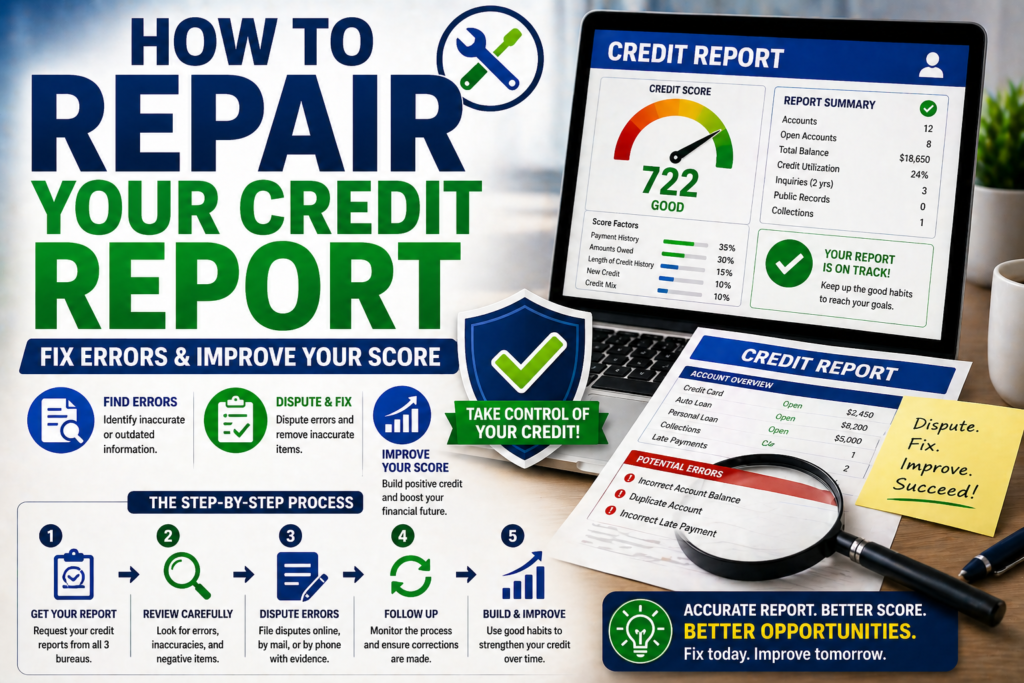
How to Repair Your Credit Report: Step-by-Step Guide to Fix Errors and Improve Your Score
Your credit report plays a critical role in your financial life—but what many people don’t realize is that it’s not always accurate. Errors, outdated information, and negative marks can significantly impact your credit score.
The good news? You can repair your credit report.
In my experience helping people fix their credit, one of the biggest surprises is how often credit reports contain mistakes—and how many people don’t know they have the right to dispute them.
Once you understand the process, repairing your credit report becomes much more manageable.
What Does It Mean to Repair Your Credit Report?
Repairing your credit report means:
- identifying errors or negative items
- disputing inaccurate information
- improving the overall accuracy of your report
👉 Important:
Credit repair is not about removing legitimate information, but about ensuring your report is correct and fair.
Step 1 — Get a Copy of Your Credit Report
You can’t fix what you haven’t reviewed.
What to do:
- request your credit report from major bureaus
- review all sections carefully
Look for:
- incorrect personal information
- accounts you don’t recognize
- duplicate entries
- wrong balances or statuses
In my experience, many people find at least one issue when they check their report for the first time.
Step 2 — Identify Errors and Negative Items
Not everything on your report is necessarily accurate.
Common errors include:
- accounts that don’t belong to you
- incorrect late payments
- outdated information
- duplicate debts
Important distinction:
- Errors → can be removed
- Accurate negative items → cannot be removed early (usually)
Understanding this difference is key to avoiding unrealistic expectations.
Step 3 — Dispute Inaccurate Information
If you find errors, you have the right to dispute them.
How to dispute:
- contact credit bureaus directly
- provide supporting evidence
- clearly explain the issue
What happens next:
- the bureau investigates
- they contact the creditor
- they update or remove incorrect information
Timeline:
- typically resolved within 30 days
In my experience, this is one of the fastest ways to improve a credit report.
Step 4 — Validate Debts
If you see a collection account, you can request validation.
What this means:
- asking the creditor to prove the debt is yours
If they cannot verify:
- the item must be removed
👉 This is a powerful step that many people overlook.
Step 5 — Negotiate With Creditors (If Needed)
For legitimate negative items, you may still have options.
Possible strategies:
- pay-for-delete agreements
- settlement negotiations
- goodwill letters
In my experience, some creditors are willing to cooperate—especially if you are proactive.
Step 6 — Build Positive Credit History
Repairing your report is not just about removing negatives—it’s also about adding positives.
Key actions:
- pay all bills on time
- keep balances low
- use credit responsibly
👉 Positive activity can offset past issues over time.
Step 7 — Monitor Your Credit Report Regularly
Credit repair is not a one-time task.
Why it matters:
- ensures errors don’t return
- tracks progress
- protects against fraud
In my experience, consistent monitoring is what separates temporary fixes from long-term success.
How Long Does It Take to Repair Your Credit Report?
The timeline depends on your situation.
Typical timelines:
| Action | Timeframe |
|---|---|
| Disputes resolved | ~30 days |
| Score improvements | 1–3 months |
| Major recovery | 6–12 months |
👉 Important:
Some improvements can happen quickly, especially when errors are removed.
Common Mistakes When Repairing Your Credit
Avoid these common errors:
Ignoring Your Credit Report
You can’t fix what you don’t review.
Disputing Everything
Only dispute inaccurate information.
Falling for “Credit Repair Scams”
Be cautious of services that promise instant fixes.
Not Building Positive Credit
Removing negatives is only part of the process.
In my experience, these mistakes can slow down or even reverse progress.
Can You Repair Your Credit Report Yourself?
Yes—you don’t need to pay a company.
Why:
- disputes can be done directly
- the process is straightforward
- it’s often free
👉 Many credit repair companies do the same steps you can do yourself.
Real Example: Credit Report Repair in Action
Scenario:
- incorrect late payment reported
- score impacted negatively
Action:
- disputed the error
- provided documentation
Result:
- item removed
- score improved within weeks
This is a very common success case I’ve seen.
Expert Strategy: The Most Effective Approach
If you want the best results:
Step 1 — Review Your Report
Find all errors.
Step 2 — Dispute Incorrect Items
Focus on accuracy.
Step 3 — Reduce Balances
Improve utilization.
Step 4 — Build Positive History
Strengthen your profile.
Step 5 — Stay Consistent
Maintain progress over time.
From my experience, people who follow this process see real improvements much faster than expected.
Conclusion
Repairing your credit report is not about shortcuts—it’s about accuracy, strategy, and consistency.
The key takeaways:
- errors can and should be disputed
- legitimate items fade over time
- positive habits are essential
- you can repair your credit yourself
Once you understand the process, you gain control over your credit—and your financial future.
FAQs
Can I remove negative items from my credit report?
Only if they are inaccurate or unverifiable.
How long does it take to repair credit?
Some improvements happen within 30 days, but full recovery can take months.
Is credit repair legal?
Yes, disputing errors is your legal right.
Do I need to pay a credit repair company?
No. You can do it yourself for free.