
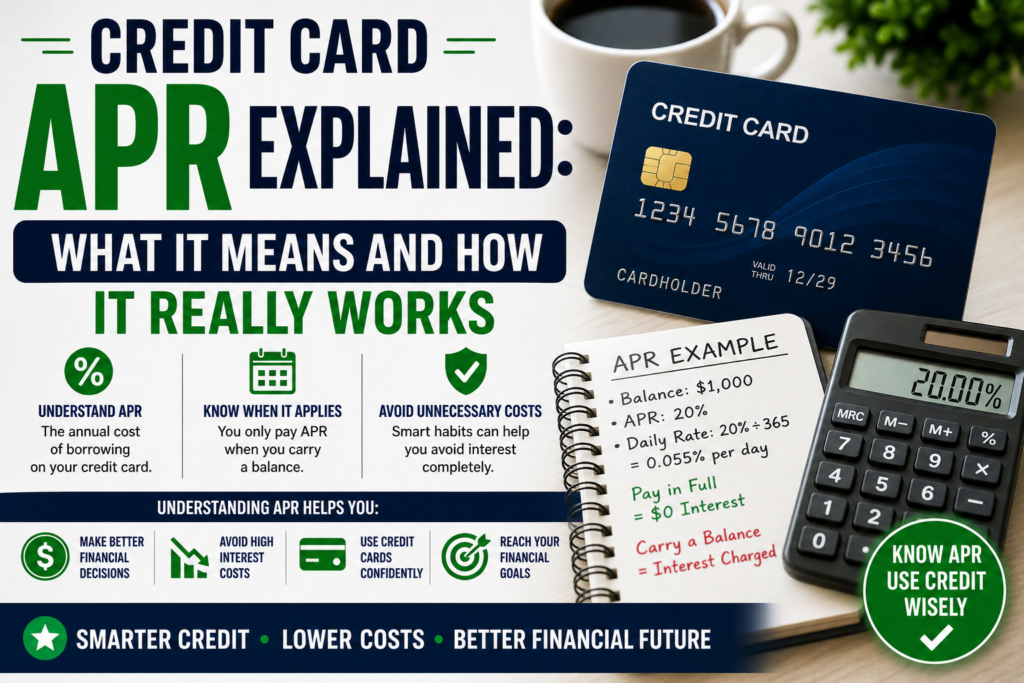
Credit Card APR Explained: What It Means and How It Really Works
Understanding APR (Annual Percentage Rate) is essential if you want to use a credit card without falling into unnecessary debt. While many people see APR as just a number, it actually determines how much borrowing money will cost you over time.
In my experience explaining APR to beginners, the biggest confusion is that people think APR is charged monthly—or that it always applies. The reality is much simpler once you break it down correctly.
What Is APR on a Credit Card?
APR stands for Annual Percentage Rate, and it represents the yearly cost of borrowing money on your credit card.
It includes:
- interest rate
- sometimes additional fees (depending on the lender)
For example:
- APR: 20%
- This means borrowing money for a year could cost 20% in interest
However, APR doesn’t always apply—this is where most people misunderstand how it works.
How Credit Card APR Works (Simple Explanation)
Let’s simplify it step by step.
Scenario:
- You spend $500 on your credit card
- Your APR is 20%
👉 What happens next depends on how you repay.
Case 1 — You Pay in Full
- You pay $500 before the due date
✅ You pay 0 interest
Case 2 — You Carry a Balance
- You pay only part of the balance
❌ Interest starts being charged
👉 Key takeaway:
- APR only applies if you don’t pay in full
In my experience, this is the most important concept people misunderstand.
APR vs Interest Rate: What’s the Difference?
Many people use these terms interchangeably, but they’re slightly different.
| Term | Meaning |
|---|---|
| Interest Rate | The cost of borrowing |
| APR | Interest rate + possible fees (annual view) |
For credit cards, APR is usually the most relevant number because it shows the true cost of borrowing over time.
How APR Is Calculated
Even though APR is expressed annually, credit cards apply interest daily.
Here’s how it works:
Step 1 — Convert APR to Daily Rate
Example:
- APR: 20%
- Daily rate ≈ 20% ÷ 365 = 0.055% per day
Step 2 — Apply to Your Balance
If you carry a balance, interest is calculated daily based on your remaining amount.
This means:
- the longer you carry a balance
- the more interest accumulates
Real Example: How APR Affects Your Balance
Let’s make it practical.
Scenario:
- Balance: $1,000
- APR: 20%
- You only pay the minimum
Over time:
- interest builds up daily
- your balance decreases slowly
- total repayment increases significantly
In real cases I’ve seen, people can end up paying hundreds in interest on relatively small balances if they only make minimum payments.
When You Actually Pay APR (And When You Don’t)
This is the most important section.
You DO NOT pay APR when:
- you pay your full balance on time
- you stay within the grace period
You DO pay APR when:
- you carry a balance
- you miss payments
- you take cash advances (often immediately)
👉 This is why credit cards can be either:
- free tools
- or expensive debt
Common APR Mistakes
Avoid these common misunderstandings.
Thinking APR Is Monthly
APR is yearly, but interest is applied daily.
Paying Only the Minimum
This keeps you in debt longer and increases total interest paid.
Ignoring the Grace Period
If you always pay in full, APR becomes irrelevant.
Not Understanding Compounding
Interest builds on previous interest over time.
In my experience, these mistakes are the main reason people struggle with credit card debt.
Expert Tips to Avoid Paying Interest
You can use credit cards without ever paying APR.
Always Pay in Full
This is the most effective strategy.
Set Automatic Payments
Avoid missed payments and interest charges.
Keep Spending Under Control
Only spend what you can repay immediately.
Track Your Billing Cycle
Understand when payments are due.
From my experience, people who follow these habits can use credit cards for years without paying a single euro or dollar in interest.
Conclusion
APR is one of the most important concepts to understand when using a credit card, but it doesn’t have to be complicated.
The key is simple:
- APR is the cost of borrowing money
- it only applies if you carry a balance
- you can completely avoid it by paying in full
Once you understand how APR works, you can use credit cards confidently and avoid unnecessary debt.
FAQs
What does APR mean on a credit card?
APR is the annual cost of borrowing money, expressed as a percentage.
Is APR charged monthly or yearly?
APR is annual, but interest is calculated daily.
Can you avoid paying APR?
Yes. Paying your full balance on time avoids interest completely.
Why is my APR so high?
Higher APRs are usually assigned to borrowers with lower credit scores or higher risk.