
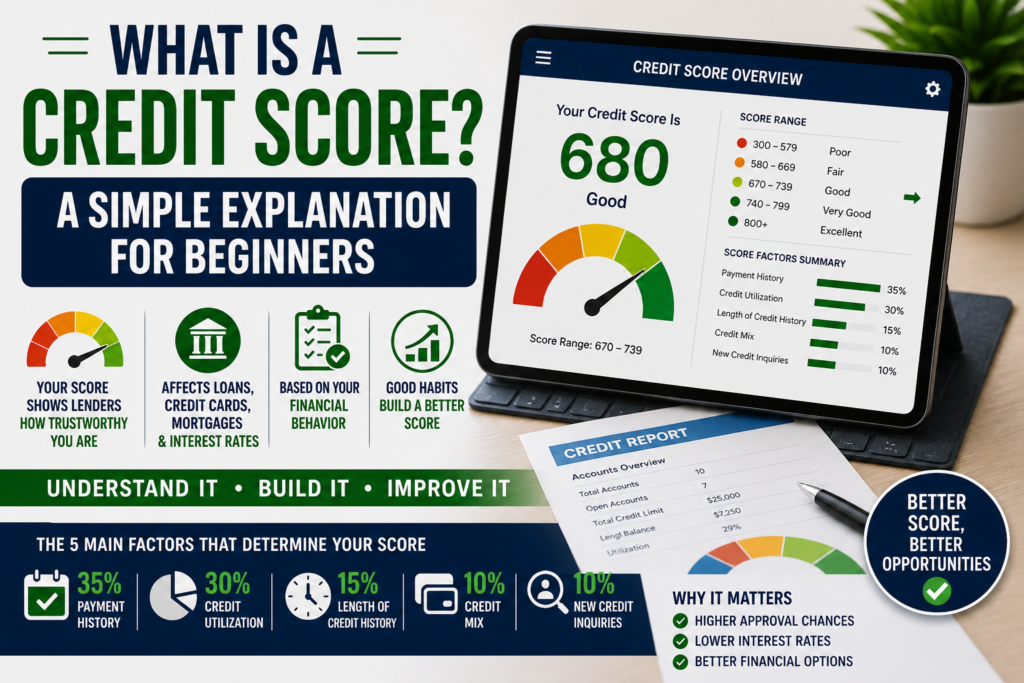
What Is a Credit Score? A Simple Explanation for Beginners
A credit score is one of the most important numbers in your financial life—but many people don’t fully understand what it actually is or how it works.
If you’ve ever wondered why lenders care about this number, or how it affects your ability to get approved for credit, you’re not alone.
In my experience explaining credit to beginners, one of the biggest misconceptions is thinking that a credit score is something you “have” like money. In reality, it’s a calculated number based on your financial behavior over time.
What Is a Credit Score?
A credit score is a number that represents how likely you are to repay borrowed money.
Lenders use this number to assess your risk as a borrower.
In simple terms:
👉 Your credit score tells lenders:
“Can this person be trusted to pay back money?”
Why Credit Scores Exist
Before credit scores, lenders had to manually review financial history, which was slow and inconsistent.
Credit scores were created to:
- standardize lending decisions
- reduce risk for lenders
- speed up approvals
Today, your credit score is one of the first things lenders check when you apply for:
- credit cards
- loans
- mortgages
Credit Score Range Explained
Most credit scores fall within a range of 300 to 850.
Here’s how they are typically classified:
| Score Range | Rating |
|---|---|
| 300–579 | Poor |
| 580–669 | Fair |
| 670–739 | Good |
| 740–799 | Very Good |
| 800+ | Excellent |
What this means
- lower scores = higher risk
- higher scores = lower risk
In my experience, many people think they need a perfect score, but in reality, a score above 670–700 is already strong.
How Credit Scores Are Calculated
Your credit score is calculated using information from your credit report.
The main factors include:
| Factor | Impact |
|---|---|
| Payment history | 35% |
| Credit utilization | 30% |
| Length of credit history | 15% |
| Credit mix | 10% |
| New credit inquiries | 10% |
Key insight
👉 Two factors—payment history and utilization—make up 65% of your score.
In my experience, focusing on these two alone can dramatically improve results.
What Information Is Used to Calculate Your Score
Your credit score is based on your financial activity, including:
- how you use credit cards
- how often you make payments
- how much debt you carry
- how long you’ve had accounts
What is NOT included:
- your income
- your age
- your job
- your savings
This is another common misunderstanding I see—your credit score is about behavior, not personal wealth.
How Credit Scores Work in Real Life
Your credit score changes based on your actions.
Example:
- you pay your credit card on time → score improves
- you miss a payment → score drops
- you use too much credit → score drops
- you reduce balances → score improves
Important concept
👉 Your score is dynamic, not fixed.
In my experience, once people understand this, they feel more in control of their credit.
Why Your Credit Score Matters
Your credit score directly affects your financial opportunities.
Higher score = benefits
- better approval chances
- lower interest rates
- higher credit limits
Lower score = limitations
- harder approvals
- higher interest rates
- fewer options
Real impact
Even a small difference in your score can result in:
- paying more interest
- higher monthly payments
Common Myths About Credit Scores
Let’s clear up some of the most common misconceptions.
“I need a perfect score”
False. Most benefits start around 700.
“Checking my score lowers it”
False. Checking your own score does not affect it.
“Closing accounts helps my score”
Often the opposite—it can hurt your credit history.
“My income affects my score”
No. Your income is not part of your credit score.
In my experience, these myths cause a lot of confusion and bad decisions.
How to Build a Good Credit Score
If you’re starting from scratch or want to improve your score:
1. Pay On Time Every Month
This is the most important factor.
2. Keep Credit Utilization Low
Aim for under 30%, ideally under 10%.
3. Keep Accounts Open
Longer history helps your score.
4. Avoid Too Many Applications
Limit hard inquiries.
5. Monitor Your Credit
Track your progress regularly.
How Long It Takes to Build a Credit Score
If you’re starting from zero:
- you may get a score in 3–6 months
- improvements take consistent behavior
Key takeaway
👉 Credit is built over time, not overnight.
Real Example: How a Credit Score Is Created
Let’s say someone opens their first credit card:
Month 1–3:
- uses card responsibly
- makes on-time payments
👉 credit profile starts forming
Month 4–6:
- consistent behavior
- low utilization
👉 credit score begins to appear
Month 6+:
- continued good habits
👉 score improves steadily
This is a common pattern I’ve seen many times.
Expert Insight: What Really Matters
From my experience, the biggest breakthroughs happen when people understand:
- credit scores are based on behavior
- small actions have big impacts
- consistency matters more than perfection
The most important habits:
- always pay on time
- keep balances low
- avoid unnecessary risk
Conclusion
A credit score is not just a number—it’s a reflection of how you manage credit over time.
The key takeaways:
- it measures your reliability as a borrower
- it’s based on your financial behavior
- it changes as your behavior changes
- you can improve it with consistent habits
Once you understand what a credit score is and how it works, you gain the ability to control it—and use it to your advantage.
FAQs
What is a credit score in simple terms?
It’s a number that shows how likely you are to repay borrowed money.
What is a good credit score?
Generally, 670 or higher is considered good.
Does income affect your credit score?
No. Credit scores are based on credit behavior, not income.
How can I improve my credit score?
Pay on time, reduce balances, and maintain good credit habits.