
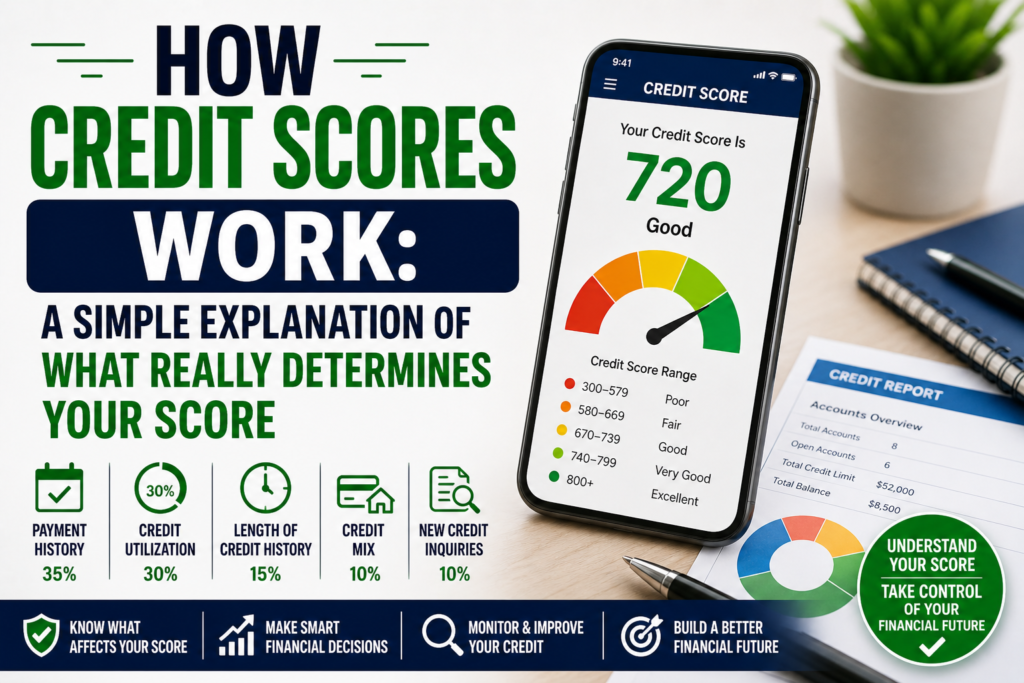
How Credit Scores Work: A Simple Explanation of What Really Determines Your Score
Credit scores can seem mysterious, but they follow a clear system based on your financial behavior. Understanding how credit scores work is one of the most powerful steps you can take to improve your financial situation.
In my experience explaining credit scores to beginners, the biggest misconception is that the score is a fixed number. In reality, your credit score is dynamic—it constantly changes based on how you use credit.
Once you understand how it works, you can start influencing it intentionally.
What Is a Credit Score?
A credit score is a number that represents how likely you are to repay borrowed money.
Lenders use it to evaluate risk when deciding:
- whether to approve you
- how much to lend
- what interest rate to offer
The most common scoring ranges are:
| Score Range | Rating |
|---|---|
| 300–579 | Poor |
| 580–669 | Fair |
| 670–739 | Good |
| 740–799 | Very Good |
| 800+ | Excellent |
How Credit Scores Are Calculated
Credit scores are calculated using data from your credit report.
The main factors include:
| Factor | Impact |
|---|---|
| Payment history | 35% |
| Credit utilization | 30% |
| Length of credit history | 15% |
| Credit mix | 10% |
| New credit inquiries | 10% |
👉 Payment history and utilization alone make up 65% of your score.
In my experience, focusing on these two factors produces the fastest and most noticeable improvements.
How Credit Scores Work in Practice
Your credit score works like a real-time reflection of your financial behavior.
Every time new information is added to your credit report:
- your score is recalculated
- it may increase or decrease
This includes actions like:
- making a payment
- increasing your balance
- opening a new account
Key insight
👉 Your score doesn’t change because of time—it changes because of new data.
This is one of the most important concepts people misunderstand.
The Most Important Factor: Payment History
Payment history has the biggest impact on your score.
It tracks whether you:
- pay on time
- miss payments
- default on accounts
Why it matters
Lenders want proof that you are reliable.
Even one missed payment can significantly lower your score.
In my experience, this is the factor that causes the biggest drops—and also the most long-term damage.
Credit Utilization: The Fastest Moving Factor
Credit utilization measures how much of your available credit you are using.
Example:
- Credit limit: $1,000
- Balance: $500 → 50% utilization
Recommended levels:
- under 30% → good
- under 10% → ideal
Why it matters
High utilization signals risk.
Low utilization shows control.
In my experience, this is the fastest way to improve your score because it updates frequently.
Length of Credit History
This factor considers how long you’ve had credit.
It includes:
- age of your oldest account
- average age of accounts
Why it matters
A longer history shows stability and experience.
Common mistake
Closing old accounts can reduce your credit history and hurt your score.
Credit Mix
Credit mix refers to the variety of credit accounts you have.
Examples:
- credit cards
- loans
- mortgages
Why it matters
It shows that you can manage different types of credit responsibly.
Important note
You don’t need many accounts—just a balanced profile over time.
New Credit Inquiries
Every time you apply for credit, a hard inquiry is added to your report.
Impact:
- small temporary drop in score
- multiple inquiries can have a larger effect
Best practice:
- apply only when necessary
- avoid multiple applications in a short period
How Your Behavior Changes Your Score
Let’s look at how common actions affect your credit score.
Positive actions:
- paying on time
- lowering balances
- maintaining low utilization
👉 These can increase your score.
Negative actions:
- missing payments
- maxing out cards
- applying for too much credit
👉 These can lower your score.
Why Credit Scores Go Up and Down
Your credit score changes because your financial behavior changes.
Example:
- you pay down a balance → score increases
- you use more credit → score decreases
Key takeaway
👉 Credit scores are not static—they are constantly evolving.
In my experience, understanding this removes a lot of confusion and frustration.
How Often Your Credit Score Updates
Your credit score updates whenever new data is reported.
Typically:
- lenders report monthly
- updates occur every 30 days
However:
- some changes can appear faster
- others may take longer
Real Example: How a Credit Score Changes
Let’s look at a practical example.
Scenario:
- Credit limit: $1,000
- Balance: $800 (80% utilization)
👉 Score is lower.
Action:
- balance reduced to $100
Result:
- utilization drops to 10%
- score increases after next report
This is one of the most common improvements I’ve seen.
Common Misconceptions About Credit Scores
“My score should update immediately”
False—updates depend on reporting cycles.
“I need a perfect score”
Not true—most benefits start around 700.
“Checking my score lowers it”
False—checking your own score is safe.
“Closing accounts helps”
Often the opposite—it can hurt your score.
Expert Strategy to Improve Your Score
If you want to improve your credit score effectively:
1. Pay Every Bill On Time
This is the most important factor.
2. Lower Your Utilization
Aim for under 30%, ideally under 10%.
3. Keep Accounts Open
Build long-term credit history.
4. Avoid Unnecessary Applications
Protect your score from inquiries.
5. Monitor Your Credit
Track changes and stay informed.
From my experience, people who understand how credit scores work are able to improve them much faster.
Conclusion
Credit scores are not random—they are calculated based on your financial behavior.
The key takeaways:
- your score is dynamic
- payment history and utilization matter most
- small actions can have a big impact
- understanding the system gives you control
Once you understand how credit scores work, you can stop guessing—and start improving your score strategically.
FAQs
How is a credit score calculated?
It’s based on factors like payment history, utilization, credit age, and inquiries.
Why does my credit score change?
Because new information is added to your credit report.
What is the most important factor?
Payment history is the biggest factor.
How can I improve my credit score?
Pay on time, reduce balances, and maintain good credit habits.