
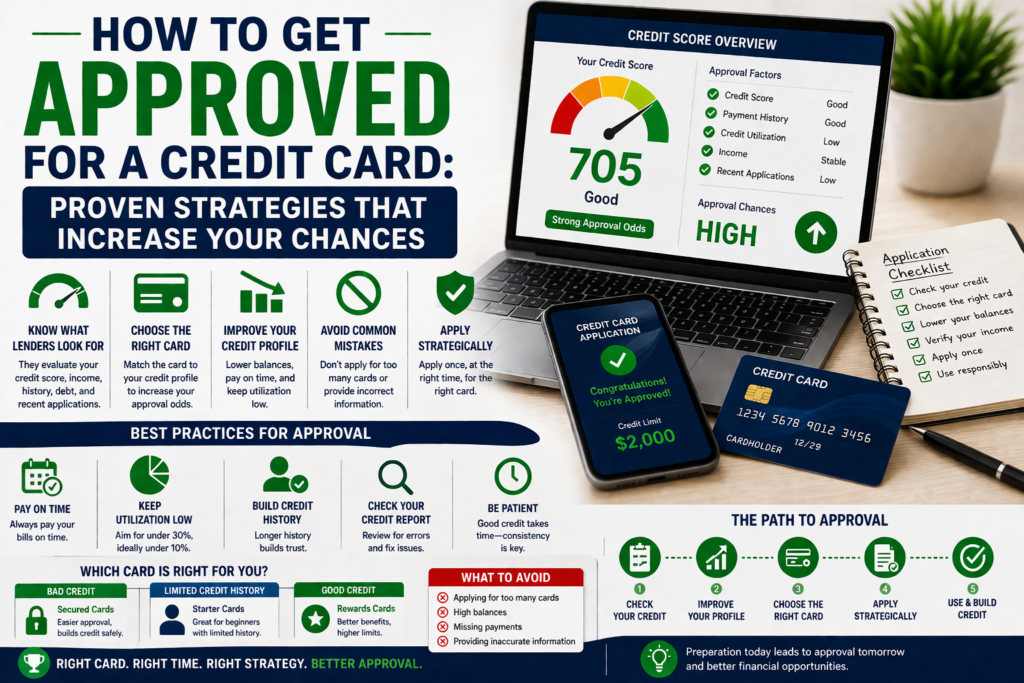
How to Get Approved for a Credit Card: Proven Strategies That Increase Your Chances
Getting approved for a credit card can feel uncertain, especially if you’re not sure what lenders are looking for. Many people apply without preparation and get rejected—often for reasons that could have been avoided.
In my experience helping people get approved for credit cards, the biggest mistake is applying blindly without understanding what lenders actually evaluate. Approval is not random—it follows clear patterns.
Once you understand those patterns, your chances increase significantly.
What Do Credit Card Issuers Look For?
Before approving your application, lenders evaluate your financial profile.
Key factors include:
- your credit score
- your income
- your credit history
- your existing debt
- recent credit applications
👉 These factors help lenders determine how risky you are as a borrower.
Minimum Requirements for Credit Card Approval
While requirements vary, most lenders expect:
Credit score:
- 580+ → basic approval possible
- 670+ → higher approval chances
- 700+ → strong approval odds
Income:
You need to demonstrate the ability to repay debt.
Credit history:
- longer history → better chances
- no history → may require beginner cards
In my experience, matching your profile to the right card is one of the most important steps.
The Biggest Mistake: Applying for the Wrong Card
One of the most common reasons for rejection is applying for a card that doesn’t match your credit level.
Example:
- applying for a premium rewards card with a low score → likely rejection
👉 Instead:
- beginners → starter or secured cards
- fair credit → basic unsecured cards
- good credit → rewards cards
In my experience, choosing the right card can double your chances of approval.
How to Get Approved for a Credit Card (Step-by-Step)
1. Check Your Credit Score First
Before applying, know where you stand.
Why it matters:
- helps you choose the right card
- prevents unnecessary rejections
2. Choose the Right Credit Card
Match your credit profile with the card type.
Options:
- secured cards → for bad/no credit
- beginner cards → limited history
- rewards cards → good credit
3. Reduce Your Credit Utilization
Lower your balances before applying.
Why it works:
- improves your credit profile
- reduces perceived risk
In my experience, this is one of the fastest ways to improve approval chances.
4. Avoid Multiple Applications
Each application creates a hard inquiry.
Why it matters:
- too many inquiries = higher risk
Best practice:
- apply for one card at a time
- wait between applications
5. Verify Your Income and Information
Make sure your application is accurate.
Include:
- stable income
- correct employment details
6. Build Some Credit First (If Needed)
If you have no credit history:
Options:
- secured credit cards
- authorized user status
- credit builder loans
In my experience, starting with a secured card often leads to faster long-term success.
How to Get Approved With Bad Credit
If your credit score is low, approval is still possible.
Best options:
- secured credit cards
- credit builder cards
- subprime cards
Strategy:
- start small
- build positive history
- upgrade later
How to Get Approved With No Credit History
If you’re starting from zero:
Best strategies:
- apply for beginner cards
- become an authorized user
- use secured cards
In my experience, building your first credit account is the hardest step—but also the most important.
What Happens If You Get Rejected?
Rejection is not the end—it’s feedback.
Common reasons:
- low credit score
- high utilization
- insufficient income
- too many recent applications
What to do next:
- review your credit report
- fix any issues
- wait before reapplying
How to Increase Your Approval Odds Quickly
Lower Your Balances
Improves your credit profile immediately.
Pay On Time
Builds trust with lenders.
Wait Between Applications
Reduces risk signals.
Apply Strategically
Choose cards aligned with your profile.
In my experience, preparation is what separates approvals from rejections.
Real Example: Getting Approved the Right Way
Scenario:
- credit score: 620
- high utilization
Action:
- reduced balances
- waited one billing cycle
- applied for a suitable card
Result:
- approval achieved
This is a very common pattern I’ve seen.
Expert Strategy for Guaranteed Progress
If your goal is approval, follow this plan:
Step 1 — Check Your Credit
Know your starting point.
Step 2 — Improve Your Profile
Lower balances and fix issues.
Step 3 — Choose the Right Card
Match your credit level.
Step 4 — Apply Once
Avoid multiple attempts.
Step 5 — Build Credit
Use your card responsibly.
From my experience, people who follow this approach significantly increase their chances of approval.
Conclusion
Getting approved for a credit card is not about luck—it’s about preparation and strategy.
The key takeaways:
- understand what lenders look for
- choose the right card
- improve your profile before applying
- avoid common mistakes
Once you approach the process strategically, your chances of approval increase dramatically.
FAQs
What credit score do you need to get approved?
Usually 580+ for basic cards, 670+ for better options.
Can I get approved with bad credit?
Yes, especially with secured or credit builder cards.
Does applying hurt your credit?
Yes, slightly—but only temporarily.
How can I improve my chances quickly?
Lower your utilization and apply for the right card.