
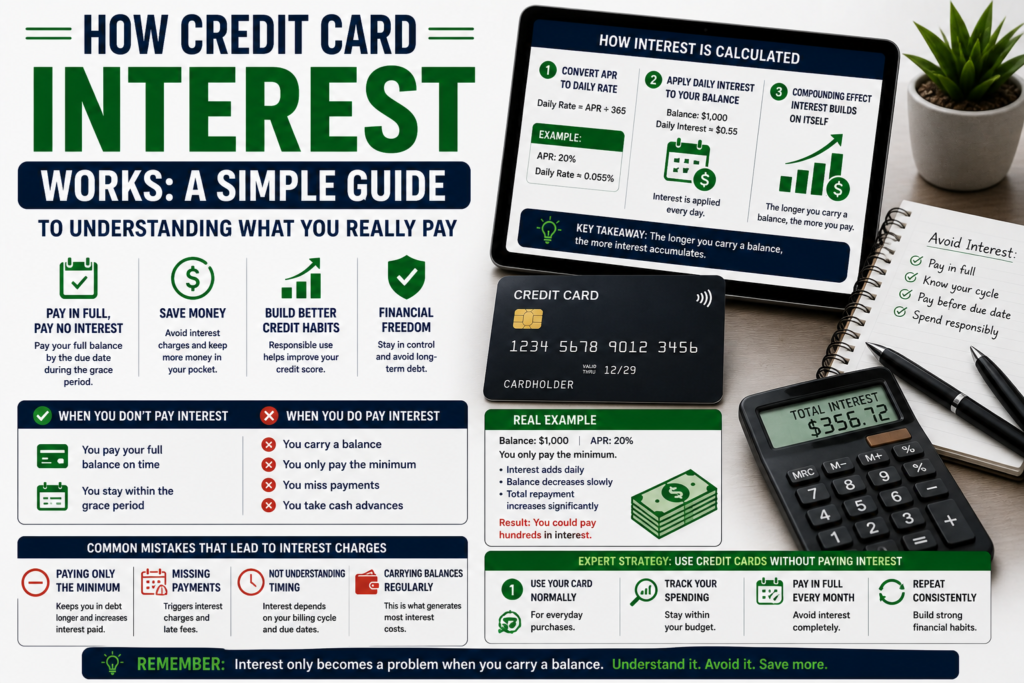
How Credit Card Interest Works: A Simple Guide to Understanding What You Really Pay
Credit card interest is one of the most misunderstood parts of personal finance. Many people know it exists—but don’t fully understand how it’s calculated or when it actually applies.
In my experience explaining credit card interest, the biggest mistake people make is thinking it’s charged monthly in a simple way. In reality, credit card interest is calculated daily, and that’s what makes it so powerful—and sometimes dangerous.
Once you understand how it works, you can avoid paying it altogether.
What Is Credit Card Interest?
Credit card interest is the cost you pay for borrowing money from your credit card issuer.
It is usually expressed as an APR (Annual Percentage Rate).
Example:
- APR: 20%
- This means borrowing money for a year could cost 20% in interest
👉 But here’s the key:
Credit card interest is not applied once per year—it’s broken down into daily calculations.
When Do You Pay Credit Card Interest?
This is the most important concept.
You DO NOT pay interest if:
- you pay your full balance on time
- you stay within the grace period
You DO pay interest if:
- you carry a balance
- you only pay the minimum
- you miss payments
- you take cash advances
In my experience, many people think interest is unavoidable—but it’s actually optional if you use your card correctly.
How Credit Card Interest Is Calculated
This is where things get interesting.
Step 1 — Convert APR to Daily Rate
Even though APR is annual, interest is calculated daily.
Formula:
Daily rate = APR ÷ 365
Example:
- APR: 20%
- Daily rate ≈ 0.055%
Step 2 — Apply Daily Interest to Your Balance
Each day, interest is applied to your remaining balance.
Example:
- Balance: $1,000
- Daily interest ≈ $0.55
👉 This happens every day until the balance is paid off.
Step 3 — Compounding Effect
Interest builds on top of previous interest.
This is called compounding.
What this means:
- the longer you carry a balance
- the more interest accumulates
In my experience, this is what traps people in long-term debt.
Real Example: How Interest Adds Up
Let’s make it simple.
Scenario:
- Balance: $1,000
- APR: 20%
- You only pay the minimum
Result:
- interest adds daily
- balance decreases slowly
- total repayment increases significantly
👉 In many real cases I’ve seen, people end up paying hundreds in interest over time.
What Is the Grace Period?
The grace period is your best friend.
Definition:
It’s the time between:
- the end of your billing cycle
- your payment due date
Key benefit:
👉 If you pay your full balance during this period → no interest is charged
In my experience, people who understand and use the grace period never pay interest.
Minimum Payments and Interest
Paying only the minimum is where problems begin.
What happens:
- most of your payment goes to interest
- your balance decreases very slowly
Example:
- Balance: $1,000
- Minimum payment: $25
👉 You may stay in debt for years.
This is one of the most common situations I see.
Why Credit Card Interest Feels So Expensive
Credit card interest is high compared to other types of loans.
Reasons:
- unsecured debt (no collateral)
- higher risk for lenders
- flexible borrowing
Typical APR:
- 15% to 25% (or more)
👉 Because of daily compounding, the real cost can feel even higher.
How to Avoid Paying Credit Card Interest
The good news: you can completely avoid it.
1. Pay Your Balance in Full
This is the simplest and most effective strategy.
2. Understand Your Billing Cycle
Know when your statement closes.
3. Pay Before the Due Date
Avoid carrying a balance.
4. Keep Your Spending Under Control
Only spend what you can repay.
In my experience, people who follow these rules can use credit cards for years without paying any interest.
Common Mistakes That Lead to Interest Charges
Avoid these mistakes:
Paying Only the Minimum
Leads to long-term debt.
Missing Payments
Triggers interest and fees.
Not Understanding Timing
Interest depends on when you pay.
Carrying Balances Regularly
This is what generates most interest costs.
In my experience, most interest problems come from lack of understanding—not bad financial habits.
How Interest Affects Your Credit Score
Interest itself doesn’t directly affect your score—but the behavior behind it does.
Indirect effects:
- high balances → higher utilization
- missed payments → negative impact
👉 So while interest doesn’t directly hurt your score, the conditions that cause it do.
Expert Strategy: Use Credit Cards Without Paying Interest
Here’s the simplest strategy I recommend:
Step 1 — Use Your Card Normally
For everyday purchases.
Step 2 — Track Your Spending
Stay within your budget.
Step 3 — Pay in Full Every Month
Avoid interest completely.
Step 4 — Repeat Consistently
Build strong financial habits.
From my experience, this approach allows you to benefit from credit cards without falling into debt.
Conclusion
Credit card interest may seem complicated, but the core idea is simple:
- it’s the cost of borrowing money
- it’s calculated daily
- it compounds over time
- it can be completely avoided
The key takeaway:
👉 Interest only becomes a problem when you carry a balance
Once you understand how it works, you can use credit cards confidently—and avoid unnecessary costs.
FAQs
Is credit card interest charged daily?
Yes. It is calculated daily based on your balance.
Can you avoid paying credit card interest?
Yes. Paying your full balance on time avoids interest.
Why is credit card interest so high?
Because it’s unsecured and flexible borrowing.
What happens if you only pay the minimum?
You’ll pay more interest and stay in debt longer.