
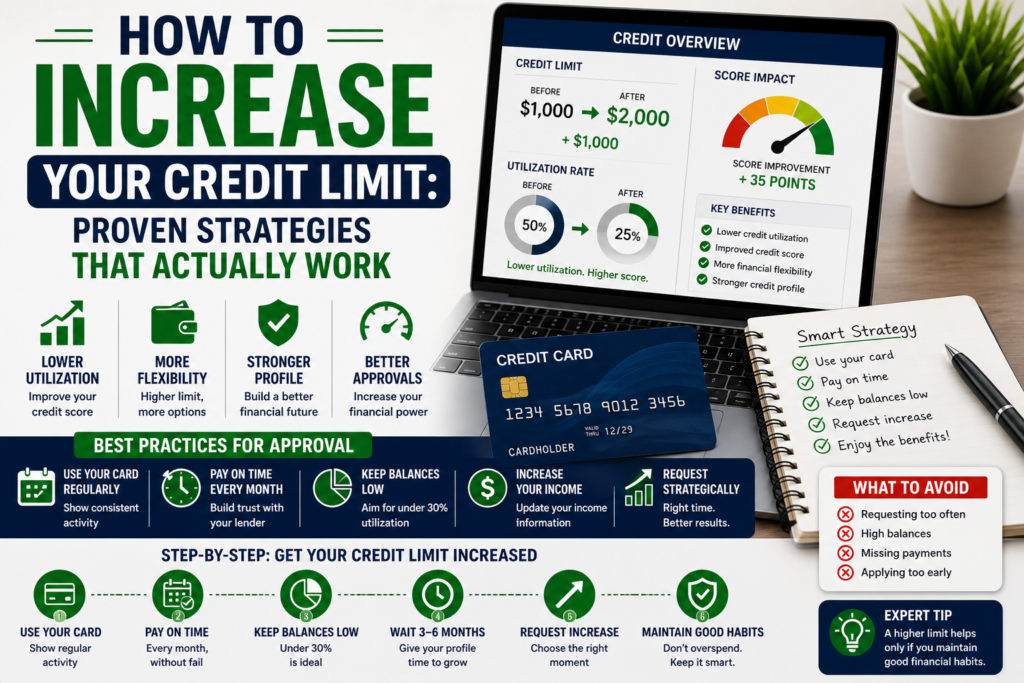
How to Increase Your Credit Limit: Proven Strategies That Actually Work
Increasing your credit limit can be one of the fastest ways to improve your financial flexibility—and even boost your credit score. But many people don’t know how to do it properly or when the right time is to ask.
In my experience helping people manage their credit, one of the biggest missed opportunities is not requesting a credit limit increase when they’re already eligible. With the right timing and strategy, it’s often easier than people think.
Why Increasing Your Credit Limit Matters
A higher credit limit isn’t just about spending more—it can actually improve your financial profile.
Key benefits:
- lowers your credit utilization
- improves your credit score
- increases purchasing flexibility
- strengthens your credit profile
Example:
- Limit: $1,000 → Balance: $500 (50% utilization)
- Limit: $2,000 → Balance: $500 (25% utilization)
👉 Same spending, better score impact.
In my experience, this is one of the fastest ways to improve a credit score without changing spending habits.
How Credit Limit Increases Work
There are two main ways your credit limit can increase:
1. Automatic Increases
Some lenders increase your limit automatically if you:
- use your card responsibly
- pay on time consistently
- show stable financial behavior
2. Requested Increases
You can also request an increase directly.
This is often done:
- through your bank app
- online account
- customer support
👉 Important:
Some requests may trigger a hard inquiry, while others don’t.
When to Ask for a Credit Limit Increase
Timing is critical.
Best times to request:
- after 3–6 months of on-time payments
- when your income increases
- when your credit score improves
- when your balances are low
In my experience, requesting too early is one of the most common reasons for rejection.
The Best Ways to Increase Your Credit Limit
1. Use Your Credit Card Regularly
Lenders want to see that you actually use your credit.
Why it matters
If you don’t use your card, there’s no reason for them to increase your limit.
Best practice:
- use your card for small purchases
- show consistent activity
2. Always Pay On Time
This is the most important factor.
Why it matters
Payment history shows reliability.
Even one late payment can reduce your chances of approval.
3. Keep Your Utilization Low
Use your credit, but don’t max it out.
Ideal range:
- under 30% → good
- under 10% → ideal
In my experience, people with low utilization are much more likely to get approved.
4. Increase Your Income (If Possible)
When requesting a limit increase, lenders may ask about your income.
Why it matters
Higher income = lower perceived risk.
Tip:
- update your income details before requesting
5. Request the Increase Strategically
Don’t just click “increase limit” randomly.
Best approach:
- check if it’s a soft or hard inquiry
- request after a strong usage period
- avoid multiple requests in a short time
In my experience, timing + preparation makes a big difference.
6. Build a Strong Credit Profile
Your overall credit matters—not just one card.
Factors that help:
- long credit history
- low debt
- few recent inquiries
What to Avoid When Requesting a Credit Limit Increase
Requesting Too Often
Multiple requests can signal risk.
Having High Balances
High utilization reduces approval chances.
Missing Payments
Even one late payment can hurt your chances.
Applying After Opening a New Account
Too many recent changes can lower approval odds.
In my experience, most rejections happen because of timing issues, not because the person isn’t qualified.
Will Increasing Your Credit Limit Affect Your Score?
It depends.
Positive effects:
- lowers utilization
- can increase your score
Possible negative effects:
- hard inquiry (temporary drop)
- if you spend more, utilization may increase
👉 Key takeaway:
A higher limit helps only if you maintain good habits.
Real Example: How a Credit Limit Increase Improves Your Score
Before:
- Limit: $1,000
- Balance: $500 (50% utilization)
After increase:
- Limit: $2,000
- Balance: $500 (25% utilization)
Result:
- lower utilization
- potential score increase
This is one of the simplest and most effective improvements I’ve seen.
Step-by-Step Strategy to Get Approved
Step 1 — Use Your Card Regularly
Show consistent activity.
Step 2 — Pay On Time Every Month
Build trust with your lender.
Step 3 — Keep Balances Low
Improve your utilization ratio.
Step 4 — Wait 3–6 Months
Give your profile time to strengthen.
Step 5 — Request the Increase
Choose the right moment.
Step 6 — Maintain Good Habits
Don’t increase spending unnecessarily.
From my experience, people who follow this approach have a much higher approval rate.
How Much Should You Ask For?
This depends on your situation.
General guideline:
- request a reasonable increase (not extreme)
- consider your income and usage
👉 Example:
- current limit: $1,000
- request: $1,500–$2,000
In my experience, realistic requests are more likely to be approved.
Conclusion
Increasing your credit limit is one of the most effective ways to improve your credit profile—but only if you do it strategically.
The key takeaways:
- timing matters
- payment history is critical
- utilization plays a big role
- preparation increases your chances
Once you understand how lenders evaluate your profile, you can increase your credit limit with confidence—and use it to improve your financial situation.
FAQs
How often can I request a credit limit increase?
Typically every 3–6 months, depending on your lender.
Does requesting a credit limit increase hurt your score?
It can if it triggers a hard inquiry, but the impact is usually small.
What is the best time to request an increase?
After several months of on-time payments and low balances.
Can I get a credit limit increase with bad credit?
It’s possible, but less likely. Improving your credit first increases your chances.