
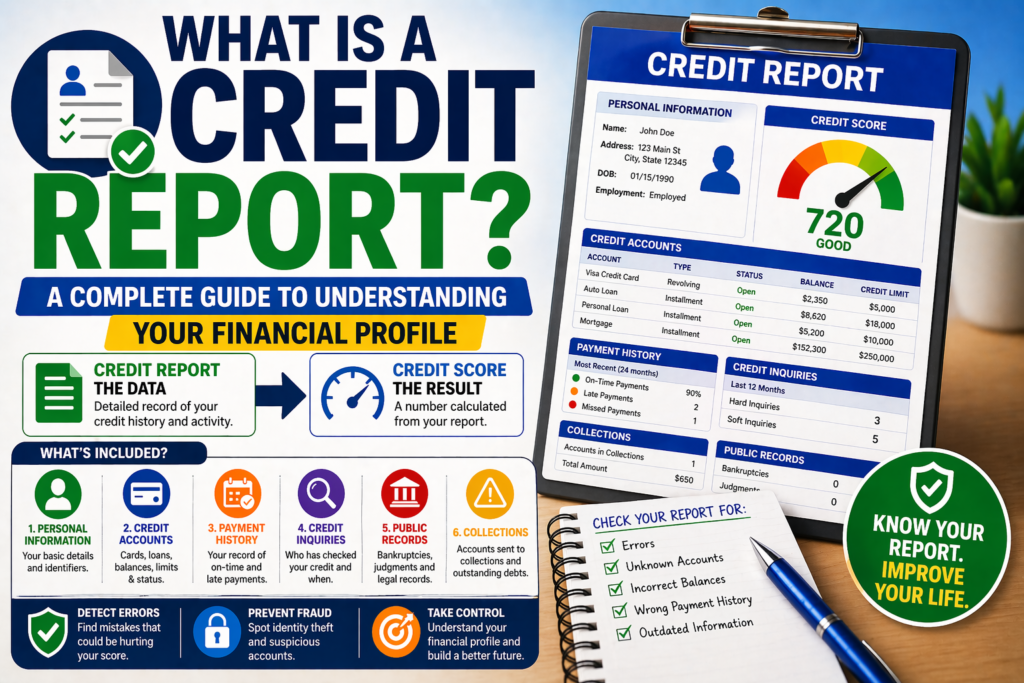
What Is a Credit Report? A Complete Guide to Understanding Your Financial Profile
A credit report is one of the most important documents in your financial life—but many people don’t fully understand what it is or why it matters.
In my experience explaining this topic, one of the biggest misconceptions is confusing a credit report with a credit score. They are related, but they are not the same thing.
👉 Your credit report is the data.
👉 Your credit score is the result of that data.
Once you understand this difference, everything else becomes much clearer.
What Is a Credit Report?
A credit report is a detailed record of your credit history and financial behavior.
It contains information about how you:
- borrow money
- use credit
- repay debts
In simple terms:
👉 It’s a financial report card that lenders use to evaluate you.
Why Credit Reports Matter
Lenders use your credit report to decide:
- whether to approve you
- how much to lend
- what interest rate to offer
It affects:
- credit cards
- loans
- mortgages
- even rental applications (in some cases)
In my experience, many people underestimate how much this document impacts their financial opportunities.
What Information Is Included in a Credit Report?
A credit report is made up of several key sections.
1. Personal Information
This includes:
- your name
- address
- date of birth
- employment information
👉 Important:
This section does not affect your score directly, but errors here can cause confusion or identity issues.
2. Credit Accounts (Tradelines)
This is the most important part.
It includes:
- credit cards
- loans
- account balances
- payment history
For each account:
- when it was opened
- credit limit
- current balance
- payment status
In my experience, this is where most problems—and opportunities—exist.
3. Payment History
This shows whether you:
- pay on time
- miss payments
- default
👉 This is the most important factor affecting your credit score.
4. Credit Inquiries
This section shows who has checked your credit.
Types:
- hard inquiries (applications)
- soft inquiries (checks without impact)
👉 Too many hard inquiries can signal risk.
5. Public Records
This includes serious financial events like:
- bankruptcies
- legal judgments
👉 These have a strong negative impact.
6. Collections
Accounts that have been sent to collection agencies.
👉 These are considered high-risk signals by lenders.
Credit Report vs Credit Score
This is one of the most important distinctions.
| Credit Report | Credit Score |
|---|---|
| Detailed history | Numerical summary |
| Shows all accounts | Single number |
| Used to calculate score | Result of report data |
👉 Think of it like this:
- report = full story
- score = summary
In my experience, understanding this difference changes how people manage their credit.
How Credit Reports Are Created
Credit reports are built using data from lenders and financial institutions.
Process:
- lenders report your activity
- credit bureaus collect the data
- report is updated regularly
👉 Updates typically happen monthly.
How Often You Should Check Your Credit Report
You should check your report regularly.
Recommended:
- at least once per year
- more often if you’re improving credit
Why:
- detect errors
- identify fraud
- track progress
In my experience, people who check their report regularly improve their credit faster.
Common Errors Found in Credit Reports
Credit reports are not always accurate.
Common issues:
- incorrect personal information
- accounts that don’t belong to you
- wrong payment statuses
- duplicate accounts
👉 Even small errors can affect your credit score.
How to Fix Errors on Your Credit Report
Step 1 — Identify the Problem
Review your report carefully.
Step 2 — Dispute the Error
Contact the credit bureau.
Step 3 — Provide Evidence
Support your claim with documents.
Step 4 — Follow Up
Ensure the correction is made.
In my experience, fixing errors is one of the fastest ways to improve your credit.
How Long Information Stays on Your Credit Report
Different items stay for different periods.
Typical timelines:
| Item | Duration |
|---|---|
| Late payments | 7 years |
| Collections | 7 years |
| Hard inquiries | 2 years |
| Bankruptcies | up to 10 years |
👉 Negative items don’t last forever—but they do take time.
How to Improve Your Credit Report
1. Pay All Bills On Time
This is the most important factor.
2. Keep Balances Low
Improve your utilization ratio.
3. Avoid Too Many Applications
Limit hard inquiries.
4. Monitor Your Report
Track changes and fix issues quickly.
5. Build Positive History
Add new, good behavior over time.
In my experience, consistent habits matter more than quick fixes.
Real Example: How a Credit Report Affects You
Scenario:
- missed payments
- high balances
Result:
- lower credit score
- harder approvals
Improvement:
- consistent on-time payments
- reduced balances
Outcome:
- better credit profile
- improved financial opportunities
👉 This is a very common progression.
Expert Insight: What Most People Get Wrong
From my experience, the biggest mistakes are:
Not Checking Their Report
They miss errors and opportunities.
Confusing Report and Score
They focus only on the number.
Ignoring Small Issues
Small errors can have big effects.
Expecting Instant Results
Credit improvement takes time.
Conclusion
A credit report is more than just a document—it’s the foundation of your financial profile.
The key takeaways:
- it records your credit history
- lenders use it to evaluate you
- it directly affects your opportunities
- you can improve it with consistent habits
Once you understand your credit report, you gain the ability to take control of your financial future.
FAQs
What is a credit report in simple terms?
It’s a record of your credit history and financial behavior.
Is a credit report the same as a credit score?
No. The report is the data, and the score is calculated from it.
How often should I check my credit report?
At least once a year, or more often if you’re improving your credit.
Can errors be removed from a credit report?
Yes, you can dispute inaccurate information.