
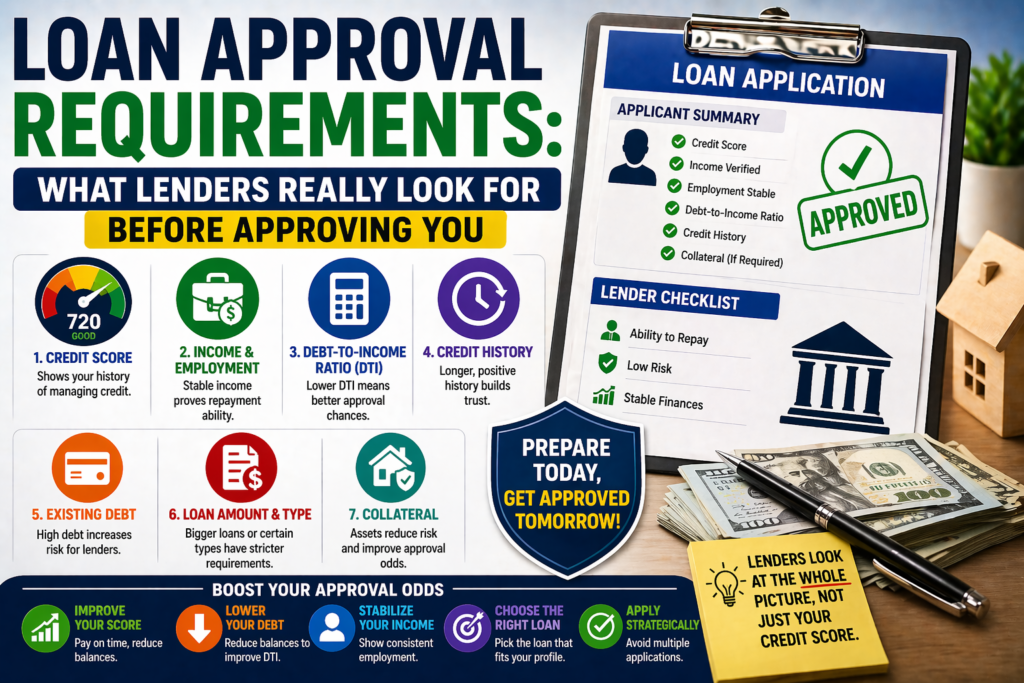
Loan Approval Requirements: What Lenders Really Look For Before Approving You
Getting approved for a loan isn’t random—it’s a structured process based on how lenders evaluate risk. The problem is that most people don’t fully understand what banks actually look for, which leads to unnecessary rejections.
In my experience helping people get approved for loans, the biggest mistake is focusing on one factor—like credit score—while ignoring other equally important elements such as income stability or debt levels.
Once you understand the full picture, your chances of approval increase significantly.
What Are Loan Approval Requirements?
Loan approval requirements are the criteria lenders use to decide whether to approve or reject your application.
These requirements help lenders answer one key question:
👉 “Can this person repay the loan?”
The Main Factors Lenders Evaluate
Lenders don’t rely on a single number—they assess your entire financial profile.
1. Credit Score (One of the Most Important Factors)
Your credit score is one of the first things lenders check.
Typical requirements:
- 580+ → basic approval possible
- 670+ → better chances
- 700+ → strong approval odds
Why it matters
Your score reflects your past behavior with credit.
In my experience, while it’s critical, it’s not the only factor—many people get rejected despite having a decent score due to other issues.
2. Income and Employment Stability
Lenders need to know you have a reliable source of income.
They look for:
- consistent employment
- stable income
- ability to repay the loan
Important insight
👉 A high income alone doesn’t guarantee approval—it must be stable and sufficient relative to your debt.
3. Debt-to-Income Ratio (DTI)
This is one of the most overlooked factors.
What is DTI?
It measures how much of your income goes toward debt payments.
Example:
- Monthly income: $3,000
- Debt payments: $1,200
- DTI: 40%
Ideal ranges:
- under 36% → good
- 36%–43% → acceptable
- above 43% → risky
In my experience, high DTI is one of the most common reasons for loan rejection.
4. Credit History
Your credit history shows how long you’ve been using credit.
Lenders prefer:
- longer history
- consistent usage
- responsible behavior
Common issue
People with short or no credit history may struggle to get approved—even if they have no debt.
5. Existing Debt
The total amount of debt you carry matters.
Lenders evaluate:
- credit card balances
- loans
- outstanding obligations
👉 High debt increases risk and lowers approval chances.
6. Loan Amount and Type
Not all loans are evaluated the same way.
Factors include:
- size of the loan
- type (personal, auto, mortgage)
- repayment terms
Example:
- larger loans → stricter requirements
- secured loans → easier approval
7. Collateral (For Secured Loans)
Some loans require collateral.
Examples:
- car loans → vehicle
- mortgages → property
Why it matters
Collateral reduces lender risk, making approval easier.
Minimum Requirements vs Real Approval Criteria
There’s a difference between:
Minimum requirements
- basic eligibility (e.g., minimum score)
Real approval criteria
- full financial profile evaluation
👉 Meeting minimum requirements doesn’t guarantee approval.
In my experience, many people misunderstand this and apply too early.
Common Reasons Loan Applications Get Rejected
Understanding rejection reasons is key.
1. Low Credit Score
Signals high risk.
2. High Debt-to-Income Ratio
Indicates limited repayment capacity.
3. Unstable Income
Raises concerns about reliability.
4. Too Many Recent Applications
Suggests financial stress.
5. Insufficient Credit History
Makes it harder to assess risk.
In my experience, most rejections come from multiple small issues combined—not just one factor.
How to Increase Your Chances of Loan Approval
1. Improve Your Credit Score
- pay on time
- reduce balances
- avoid missed payments
2. Lower Your Debt-to-Income Ratio
- pay down existing debt
- avoid taking new debt
3. Increase or Stabilize Your Income
- show consistent earnings
- avoid frequent job changes
4. Choose the Right Loan
Match your profile to the loan type.
5. Avoid Multiple Applications
Apply strategically, not repeatedly.
In my experience, preparation is the difference between approval and rejection.
Real Example: Loan Approval Scenario
Before:
- credit score: 650
- high credit card balances
- DTI: 45%
Action:
- reduced balances
- lowered DTI to 35%
Result:
- loan approved
👉 This is a common improvement path I’ve seen.
Expert Strategy: Step-by-Step Approval Plan
Step 1 — Check Your Credit
Know your starting point.
Step 2 — Reduce Debt
Improve your DTI.
Step 3 — Stabilize Income
Ensure consistency.
Step 4 — Choose the Right Loan
Match your profile.
Step 5 — Apply Once
Avoid multiple inquiries.
From my experience, this structured approach dramatically improves approval chances.
How Long It Takes to Become Loan-Ready
Typical timelines:
| Situation | Time to Improve |
|---|---|
| Minor issues | 1–3 months |
| Moderate issues | 3–6 months |
| Major issues | 6–12+ months |
👉 Improvements can happen faster than most people expect.
Conclusion
Loan approval is not about luck—it’s about meeting the right criteria.
The key takeaways:
- lenders evaluate your full financial profile
- credit score is important—but not everything
- debt-to-income ratio is critical
- preparation increases approval chances
Once you understand what lenders are looking for, you can position yourself strategically and significantly improve your chances of getting approved.
FAQs
What is the most important requirement for a loan?
Credit score and debt-to-income ratio are the most important factors.
Can I get a loan with bad credit?
Yes, but options may be limited and interest rates higher.
How can I improve my chances of approval?
Lower your debt, improve your credit score, and apply strategically.
Does income guarantee approval?
No. It must be stable and sufficient relative to your debt.