
How Loan Interest Works: A Simple Guide to Understanding What You Really Pay
Loan interest is the cost of borrowing money—but most people don’t fully understand how it actually works in practice. This lack of understanding often leads to paying more than expected over time.
In my experience explaining loans, one of the biggest misconceptions is thinking that interest is evenly distributed across payments. In reality, most loans are structured so that you pay more interest at the beginning and more principal later.
Once you understand how loan interest works, you can make smarter borrowing decisions and potentially save a significant amount of money.
What Is Loan Interest?
Loan interest is the fee a lender charges for allowing you to borrow money.
It is usually expressed as a percentage called the interest rate.
Example:
- Loan amount: $10,000
- Interest rate: 10%
👉 This means you will pay extra on top of the borrowed amount over time.
Types of Loan Interest
There are two main types of interest used in loans.
1. Simple Interest
Simple interest is calculated only on the original loan amount (principal).
Formula:
Interest = Principal × Rate × Time
Example:
- Loan: $1,000
- Rate: 10%
- Time: 1 year
👉 Interest = $100
Key feature:
- predictable
- does not compound
2. Compound Interest
Compound interest is calculated on:
- the principal
- plus previously accumulated interest
What this means:
- interest grows over time
- total cost increases faster
In my experience, this is where many borrowers underestimate the real cost of loans.
How Loan Interest Is Applied in Real Life
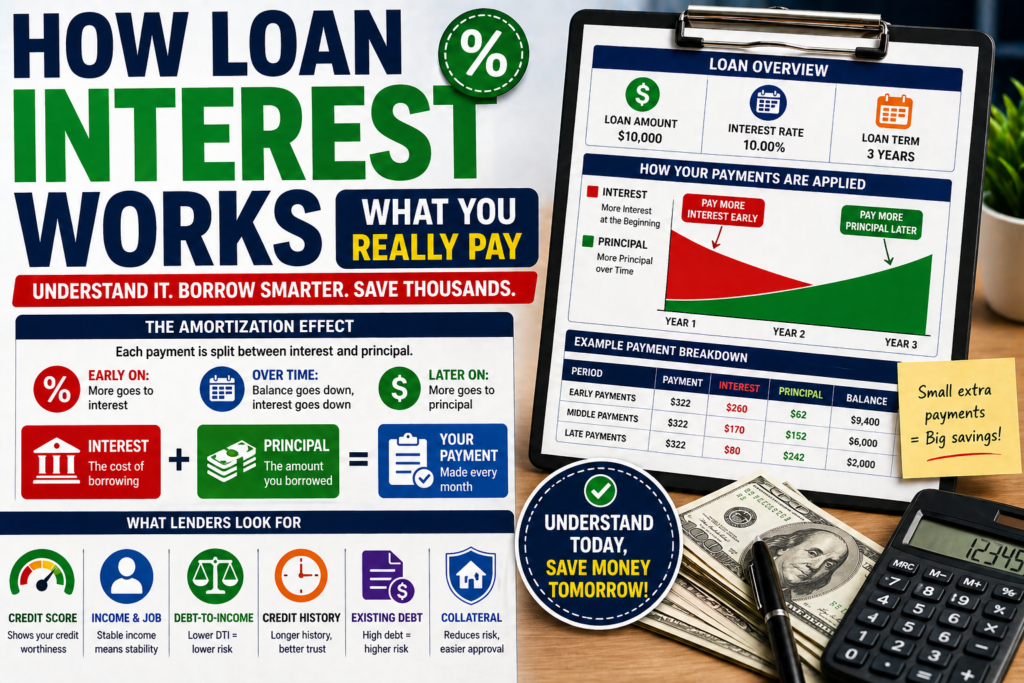
Most loans (especially personal loans, auto loans, and mortgages) use amortization.
What Is Amortization?
Amortization is the process of spreading loan payments over time.
Each payment includes:
- interest
- principal (the actual loan amount)
Key Insight
👉 At the beginning of the loan:
- more of your payment goes to interest
- less goes to principal
👉 Later in the loan:
- more goes to principal
- less to interest
This is one of the most important concepts I explain to people.
Real Example: How Payments Work
Scenario:
- Loan: $10,000
- Interest rate: 10%
- Term: 3 years
Early payments:
- larger portion = interest
- smaller portion = principal
Later payments:
- larger portion = principal
- smaller portion = interest
👉 This is why paying early can save money.
Why You Pay More Interest at the Beginning
This happens because interest is calculated on the remaining balance.
At the start:
- balance is highest → interest is highest
Over time:
- balance decreases → interest decreases
In my experience, understanding this helps people make smarter repayment decisions.
Fixed vs Variable Interest Rates
Fixed Rate
- stays the same over time
- predictable payments
Variable Rate
- can change based on market conditions
- payments may increase or decrease
👉 Fixed rates offer stability, while variable rates can be riskier.
Factors That Affect Your Loan Interest Rate
Lenders determine your rate based on risk.
Key factors:
- credit score
- income
- debt-to-income ratio
- loan type
- loan term
In my experience, credit score is often the biggest factor—but not the only one.
How Loan Interest Affects the Total Cost
Interest significantly increases the total amount you repay.
Example:
- Loan: $10,000
- Total paid: $12,000+
👉 That extra amount is interest.
Key takeaway:
The longer the loan term:
- the more interest you pay
How to Reduce the Interest You Pay
1. Make Extra Payments
Paying more than the minimum reduces your balance faster.
2. Choose a Shorter Loan Term
Shorter loans = less total interest.
3. Improve Your Credit Score
Better credit = lower interest rates.
4. Refinance Your Loan
Replacing your loan with a lower-rate option can save money.
5. Pay Early in the Loan
This reduces interest during the most expensive phase.
In my experience, even small extra payments can lead to significant savings.
Common Mistakes About Loan Interest
Thinking Interest Is Evenly Distributed
It’s not—most is paid early.
Focusing Only on Monthly Payment
Lower payments often mean higher total interest.
Ignoring Loan Term
Longer terms increase total cost.
Not Comparing Rates
Different lenders offer different costs.
In my experience, these mistakes can cost borrowers thousands over time.
Real Example: Saving on Interest
Scenario:
- Loan: $10,000
- Extra payments made monthly
Result:
- loan paid off faster
- less total interest paid
👉 This is one of the simplest ways to save money.
Expert Strategy: How to Minimize Interest Costs
Step 1 — Get the Best Rate
Improve your credit before applying.
Step 2 — Choose the Right Term
Balance affordability and total cost.
Step 3 — Pay More Than Required
Reduce principal faster.
Step 4 — Avoid Unnecessary Borrowing
Only borrow what you need.
Step 5 — Monitor Your Loan
Track progress and adjust payments.
From my experience, people who follow this approach save significantly over time.
Conclusion
Loan interest is not just a small fee—it’s a major part of the total cost of borrowing.
The key takeaways:
- interest is the cost of borrowing money
- most loans use amortization
- you pay more interest at the beginning
- small changes can reduce total costs significantly
Once you understand how loan interest works, you can borrow smarter and avoid unnecessary expenses.
FAQs
What is loan interest in simple terms?
It’s the cost you pay for borrowing money.
Why do I pay more interest at the beginning?
Because your loan balance is higher.
Can I reduce the interest I pay?
Yes, by making extra payments and choosing better loan terms.
What is better: fixed or variable interest?
Fixed is more predictable; variable can be cheaper but riskier.