
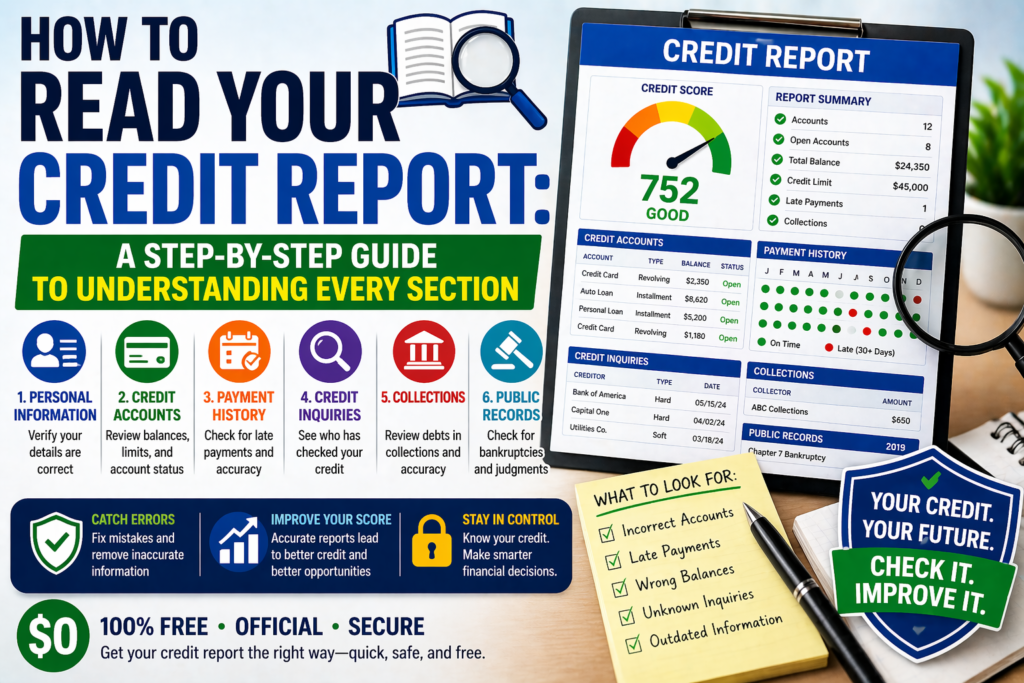
How to Read Your Credit Report: A Step-by-Step Guide to Understanding Every Section
Reading your credit report can feel overwhelming at first. It’s full of numbers, accounts, and terms that aren’t always easy to understand. But once you know what to look for, it becomes one of the most powerful tools for improving your financial situation.
In my experience helping people review their credit reports, the biggest issue is not accessing the report—it’s not knowing what matters and what to ignore.
Most people skim through it without identifying errors or understanding how each section affects their credit.
Why It’s Important to Read Your Credit Report
Your credit report directly affects:
- loan approvals
- credit card applications
- interest rates
- financial opportunities
👉 If there’s an error, it can:
- lower your credit score
- reduce approval chances
In my experience, people who regularly review their credit report catch problems early and improve their credit faster.
What You’ll See in a Credit Report
A credit report is divided into several sections.
Understanding each one is key.
1. Personal Information Section
This includes:
- name
- address
- date of birth
- employment details
What to check:
- incorrect addresses
- wrong names
- outdated information
👉 Errors here can indicate identity issues or fraud.
2. Credit Accounts (Tradelines)
This is the most important section.
For each account, you’ll see:
- account type (credit card, loan)
- credit limit
- current balance
- payment history
- account status
What to look for:
- incorrect balances
- accounts you don’t recognize
- wrong payment statuses
In my experience, this is where most impactful errors are found.
3. Payment History
This shows whether you:
- paid on time
- missed payments
- had late payments
Why it matters:
👉 Payment history is the biggest factor affecting your credit score.
What to check:
- incorrect late payments
- accounts marked late by mistake
4. Credit Inquiries Section
This shows who has checked your credit.
Types:
- hard inquiries → from applications
- soft inquiries → background checks
What to look for:
- unknown inquiries
- too many recent applications
👉 Too many hard inquiries can lower your score.
5. Collections Section
Accounts sent to collection agencies.
What to check:
- accuracy of the debt
- duplicate entries
- outdated collections
👉 These have a strong negative impact.
6. Public Records
Includes:
- bankruptcies
- legal judgments
What to check:
- accuracy
- correct dates
👉 These are serious negative marks.
Step-by-Step: How to Read Your Credit Report
Step 1 — Start With Personal Information
Verify all details are correct.
Step 2 — Review All Accounts
Check each account carefully.
Step 3 — Analyze Payment History
Look for errors or inconsistencies.
Step 4 — Check Inquiries
Ensure all inquiries are legitimate.
Step 5 — Review Collections and Public Records
Confirm accuracy and timelines.
👉 This systematic approach ensures nothing is missed.
What to Look for Specifically (Most People Miss This)
This is where most people fail.
Key red flags:
- accounts you don’t recognize
- incorrect late payments
- duplicate accounts
- wrong balances
- outdated negative items
In my experience, even one small error can affect your score significantly.
Common Mistakes When Reading a Credit Report
Skimming Instead of Reviewing
People don’t check details carefully.
Ignoring Small Errors
Small issues can have big effects.
Not Understanding Terms
Misinterpreting data leads to confusion.
Not Checking Regularly
Problems go unnoticed for too long.
In my experience, these mistakes prevent people from improving their credit.
How to Fix Errors You Find
Step 1 — Identify the Issue
Be specific.
Step 2 — Dispute the Error
Contact the credit bureau.
Step 3 — Provide Evidence
Support your claim.
Step 4 — Follow Up
Ensure corrections are made.
👉 Disputes are usually resolved within 30 days.
Real Example: Reading a Credit Report Correctly
Scenario:
- report shows a late payment
Action:
- review account history
- confirm it was paid on time
- file dispute
Result:
- error removed
- credit score improved
👉 This is a very common situation I’ve seen.
How Often You Should Read Your Credit Report
Recommended:
- at least once per year
- every few months if improving credit
👉 Regular checks help detect errors early.
Expert Strategy: How to Use Your Credit Report to Improve Your Score
Step 1 — Identify Errors
Remove anything incorrect.
Step 2 — Reduce Balances
Improve utilization.
Step 3 — Pay On Time
Build positive history.
Step 4 — Monitor Progress
Track improvements.
Step 5 — Stay Consistent
Maintain good habits.
From my experience, people who actively use their credit report improve their scores much faster.
Conclusion
Reading your credit report is not just about understanding it—it’s about using it as a tool to improve your financial situation.
The key takeaways:
- your credit report contains critical financial data
- each section has a specific purpose
- errors can impact your score
- regular review helps you stay in control
Once you know how to read your credit report, you can make smarter decisions and take control of your financial future.
FAQs
What is the most important part of a credit report?
Payment history and account details are the most important.
How do I know if there’s an error?
Look for incorrect accounts, balances, or payment statuses.
How often should I check my report?
At least once a year, or more often if improving credit.
Can I fix errors myself?
Yes, you can dispute errors directly with credit bureaus.