
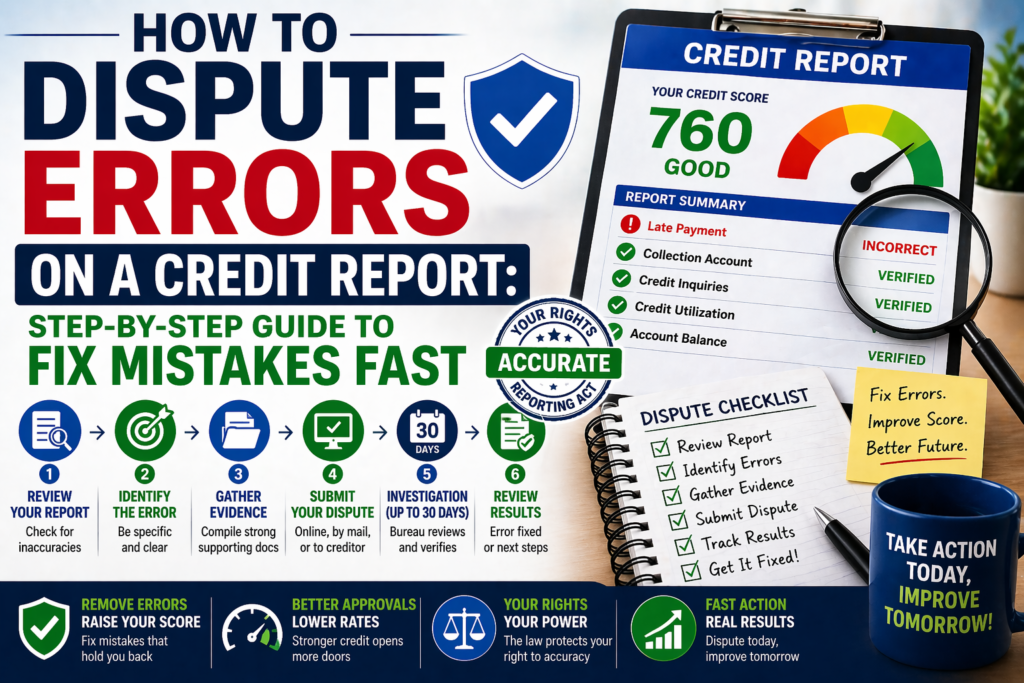
How to Dispute Errors on a Credit Report: Step-by-Step Guide to Fix Mistakes Fast
Errors on your credit report can lower your credit score and affect your ability to get approved for loans, credit cards, and even housing. The good news is that you have the legal right to dispute inaccurate information—and fix it.
In my experience helping people correct credit report errors, one of the biggest problems is not the dispute itself—it’s how the dispute is done. Many people submit incomplete or weak claims, which leads to rejections.
When done correctly, disputing errors can lead to fast and significant improvements in your credit profile.
What Does It Mean to Dispute a Credit Report Error?
Disputing an error means formally challenging incorrect or inaccurate information on your credit report.
You can dispute:
- accounts that don’t belong to you
- incorrect late payments
- wrong balances
- duplicate accounts
- outdated negative items
👉 Important:
You should only dispute inaccurate or unverifiable information.
Why Disputing Errors Is Important
Even small mistakes can have a big impact.
Errors can:
- lower your credit score
- reduce approval chances
- increase interest rates
In my experience, removing just one incorrect negative item can significantly improve a credit score.
Step-by-Step: How to Dispute Errors on Your Credit Report
Step 1 — Get Your Credit Report
Start by reviewing your full report.
Look for:
- incorrect accounts
- wrong payment history
- unfamiliar activity
👉 You can’t dispute what you don’t identify.
Step 2 — Identify the Exact Error
Be specific.
Example:
- “Late payment reported incorrectly for March 2024”
👉 Vague disputes are more likely to fail.
Step 3 — Gather Supporting Evidence
This is where most people fail.
Examples of evidence:
- payment confirmations
- bank statements
- account records
- correspondence
In my experience, strong documentation dramatically increases success rates.
Step 4 — Submit Your Dispute
You can file disputes in multiple ways:
Online
- fastest method
- easy tracking
By Mail
- more formal
- useful for complex cases
Directly with the Creditor
- sometimes faster resolution
Step 5 — Wait for Investigation
After submission:
- the credit bureau investigates
- they contact the creditor
- they verify the information
Timeline:
👉 usually 30 days
Step 6 — Review the Results
Possible outcomes:
Error confirmed
- item is corrected or removed
Verified as accurate
- no change
👉 If rejected, you still have options.
What to Do If Your Dispute Is Rejected
This is where most guides stop—but it’s critical.
1. Review the Reason for Rejection
Understand why it failed.
2. Provide Additional Evidence
Stronger documentation can change the outcome.
3. Dispute Again
You can refile with better information.
4. Contact the Creditor Directly
Sometimes faster than going through bureaus.
5. Add a Consumer Statement
Explain your situation on your report.
In my experience, persistence is often the key to success.
Common Mistakes When Disputing Errors
Not Providing Evidence
Weak claims get rejected.
Disputing Accurate Information
Wastes time and effort.
Being Too Vague
Lack of detail reduces credibility.
Not Following Up
Missed opportunities to fix issues.
In my experience, most failed disputes are due to poor preparation—not invalid claims.
How Disputes Affect Your Credit Score
If successful:
- negative items removed
- score may increase
If unsuccessful:
- no direct impact
- but issue remains
👉 Disputing errors does not hurt your score.
Real Example: Successful Credit Dispute
Scenario:
- incorrect late payment reported
Action:
- gathered payment proof
- submitted detailed dispute
Result:
- item removed
- credit score improved
👉 This is a common and powerful outcome.
How Long It Takes to See Results
Typical timeline:
| Stage | Time |
|---|---|
| Dispute submission | immediate |
| Investigation | ~30 days |
| Score update | shortly after |
👉 Some improvements can happen within weeks.
Expert Strategy: How to Win Credit Disputes
Step 1 — Be Specific
Clearly define the error.
Step 2 — Provide Strong Evidence
Support your claim.
Step 3 — Use Clear Language
Avoid confusion.
Step 4 — Follow Up
Don’t stop after one attempt.
Step 5 — Stay Organized
Track all disputes and responses.
From my experience, people who follow this approach have a much higher success rate.
When You Should NOT Dispute
Avoid disputing:
- accurate information
- recent valid accounts
- legitimate late payments
👉 Disputing everything blindly can backfire.
Conclusion
Disputing errors on your credit report is one of the most effective ways to improve your credit—but only if done correctly.
The key takeaways:
- only dispute inaccurate information
- strong evidence is essential
- persistence increases success
- results can happen faster than expected
Once you understand how to dispute errors properly, you can take control of your credit and fix issues that may be holding you back.
FAQs
How long does a credit dispute take?
Usually around 30 days.
Can I dispute errors online?
Yes, and it’s often the fastest method.
What if my dispute is rejected?
You can submit it again with stronger evidence.
Will disputing hurt my credit score?
No, it does not negatively impact your score.