
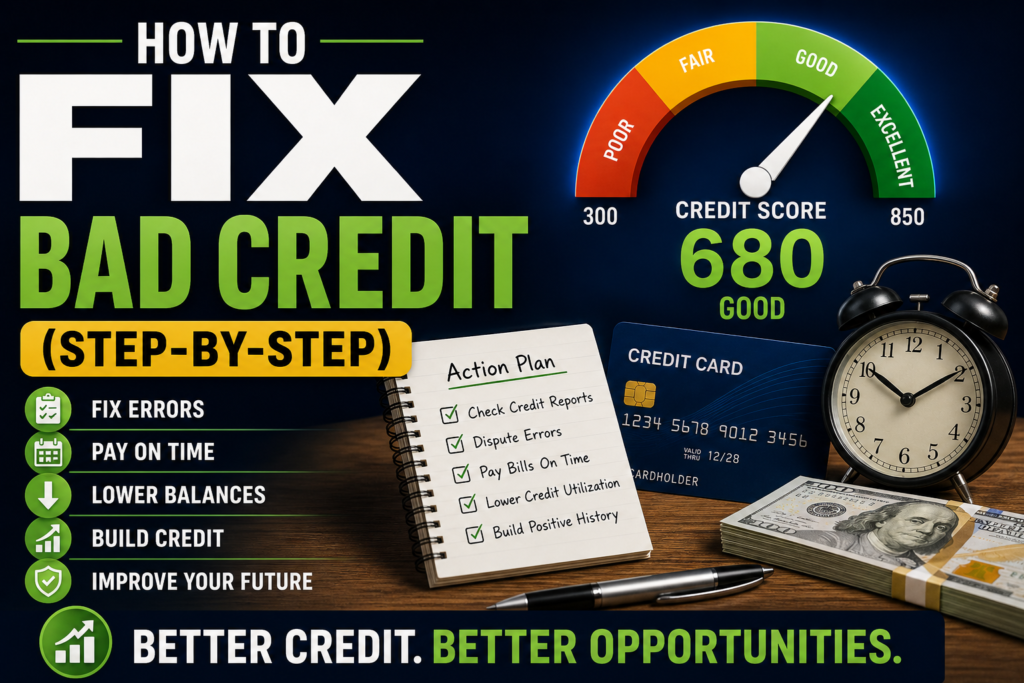
How to Fix Bad Credit (Step-by-Step)
Bad credit can make life expensive. Higher interest rates, loan rejections, and difficulty renting an apartment are common problems when your credit score is low. The good news is that bad credit is fixable, and with the right strategy you can rebuild your financial reputation over time.
In my experience working with people trying to repair their credit, most assume their situation is permanent. In reality, once you understand how credit works and follow a structured plan, credit scores often start improving within a few months.
This guide explains exactly how to fix bad credit step-by-step, what mistakes to avoid, and how long it typically takes to see results.
What Bad Credit Really Means
A credit score is a numerical representation of how trustworthy you appear to lenders. Most lenders use scoring models created by FICO, which typically range from 300 to 850.
General ranges:
| Score | Rating |
|---|---|
| 300-579 | Poor |
| 580-669 | Fair |
| 670-739 | Good |
| 740-799 | Very Good |
| 800+ | Excellent |
Bad credit usually means your score falls below 580.
This can happen because of:
- Late payments
- Accounts in collections
- High credit card balances
- Bankruptcy or defaults
- Too many credit applications
One thing I often tell clients is that credit scores are not a judgment of your character. They are simply the result of patterns in your financial behavior.
How Credit Scores Work
Before fixing bad credit, it helps to understand what actually affects your score.
The 5 Factors That Affect Your Credit Score
According to most scoring models, these factors matter most:
| Factor | Impact |
|---|---|
| Payment history | 35% |
| Credit utilization | 30% |
| Credit history length | 15% |
| Credit mix | 10% |
| New credit inquiries | 10% |
Your payment history and credit utilization alone account for about 65% of your score, which means fixing those areas can create the biggest improvement.
Credit data is tracked by agencies like:
- Experian
- Equifax
- TransUnion
These agencies collect information from lenders and use it to build your credit report.
Step-by-Step: How to Fix Bad Credit
1. Check Your Credit Reports for Errors
The first step is reviewing your credit reports carefully.
In my experience analyzing credit reports, errors appear more often than most people expect. Incorrect late payments, outdated collections, or duplicate accounts can all lower your score unfairly.
Look for:
- Accounts you don’t recognize
- Incorrect balances
- Late payments that were actually on time
- Duplicate accounts
- Old debts that should be removed
Even one incorrect negative mark can significantly impact your score.
2. Dispute Incorrect Information
If you find errors, dispute them with the credit bureaus.
Most disputes involve:
- Identity errors
- Incorrect payment history
- Accounts that don’t belong to you
When the bureau cannot verify the information with the lender, they must remove it from your report.
I’ve seen clients gain 30–80 points simply by correcting inaccurate data.
3. Pay Every Bill on Time
Payment history is the single most important factor affecting your credit score.
Even one late payment can damage your credit for years.
Best practices include:
- Set automatic payments
- Use payment reminders
- Pay at least the minimum before the due date
Many people underestimate how powerful consistent payments are. When clients begin paying every bill on time, scores often improve steadily within 3–6 months.
4. Lower Your Credit Utilization
Credit utilization measures how much of your available credit you’re using.
Example:
If your credit limit is $5,000 and your balance is $3,000, your utilization is 60%.
Experts recommend staying below 30%, and ideally below 10%.
Strategies to reduce utilization:
- Pay down balances aggressively
- Make multiple payments per month
- Request higher credit limits
Reducing utilization is often one of the fastest ways to increase a credit score.
5. Become an Authorized User
If someone with good credit adds you as an authorized user on their credit card, their positive payment history may appear on your credit report.
This strategy works best when the card has:
- Long history
- Low balance
- Perfect payment record
I’ve seen this tactic help people establish credit months faster than starting from zero.
6. Use a Secured Credit Card
A secured credit card requires a deposit that becomes your credit limit.
Example:
Deposit $300 → $300 credit limit.
This allows people with poor credit to rebuild a positive payment history.
To use it effectively:
- Keep utilization low
- Pay the balance in full each month
- Avoid carrying high balances
Many people are surprised that using a secured card responsibly can increase credit scores within a few reporting cycles.
7. Avoid Too Many Credit Applications
Every time you apply for credit, a hard inquiry appears on your report.
Too many inquiries signal financial risk to lenders.
Best practices:
- Apply only when necessary
- Space applications several months apart
- Focus on improving existing accounts
One mistake I frequently see is people applying for multiple cards hoping one gets approved, which often lowers their score further.
Common Mistakes That Keep Credit Scores Low
While helping people rebuild credit, I repeatedly see the same errors.
Ignoring Old Debts
Unpaid collections continue affecting your report until resolved.
Closing Old Credit Cards
Older accounts increase the length of credit history, which benefits your score.
Maxing Out Credit Cards
High utilization can drop scores quickly.
Paying Late “Just Once”
Even a single late payment can remain on your credit report for up to seven years.
Avoiding these mistakes can accelerate your credit recovery.
How Long It Takes to Fix Bad Credit
Credit repair is not instant, but improvements can appear faster than many expect.
Typical timeline:
| Timeframe | Potential Results |
|---|---|
| 1–3 months | Correct errors, lower balances |
| 3–6 months | Noticeable score increases |
| 6–12 months | Strong credit recovery |
| 12–24 months | Major credit rebuild |
In my experience, people who follow a structured plan consistently can increase their score by 100 points or more within a year.
Advanced Strategies to Rebuild Credit Faster
Once the basics are under control, additional strategies can accelerate improvement.
Credit Builder Loans
These loans help establish payment history while saving money.
Reporting Rent Payments
Some services allow rent payments to appear on credit reports.
Debt Consolidation
Combining multiple debts into one payment can simplify repayment and lower utilization.
Each strategy should be used carefully, but when implemented correctly they can help rebuild credit faster.
Final Tips to Maintain a Good Credit Score
Once your credit improves, maintaining it becomes much easier.
Key habits include:
- Always paying bills on time
- Keeping credit utilization low
- Monitoring your credit report regularly
- Avoiding unnecessary debt
Credit scores reward consistent financial behavior over time. Once positive patterns are established, your score tends to remain stable and continue improving.
FAQs
Can bad credit be fixed quickly?
While some improvements can happen in a few months, fully rebuilding credit typically takes 6–24 months depending on the situation.
Does paying off collections improve credit?
Sometimes. Newer scoring models may ignore paid collections, but removing them entirely is usually better.
What is the fastest way to improve a credit score?
Lowering credit utilization and correcting report errors often produce the fastest results.
Can you fix bad credit yourself?
Yes. Most credit repair steps—checking reports, disputing errors, and paying bills on time—can be done without hiring a credit repair company.